

like moths to light
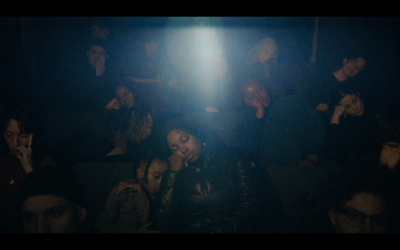
The new film by artist Gala Hernández López, presented for the first time as an installation, explores our dreams in the age of artificial intelligence and new forms of control. like moths to light reflects on the future of our dream worlds in the era of neurocapitalism.
In this film, a woman speaks from inside a machine that records her brain activity. She describes a mental labyrinth blending an old amusement park named Dreamland, 19th-century psychic photographs, contemporary experiments in brain decoding using AI, and Prophetic, a startup whose goal is to control dreams. But what do our dreams see when they look at us?
Night is a space for introspection: the subject breaks free from the rational logic of the day to explore the unconscious and the superfluous. It constitutes a space of silent resistance to the productivist rhythm of daily life. The film like moths to light weaves interconnected narratives around technologies for manipulating and decoding dreams, revealing humanity’s historical obsession with total transparency and mastery of the invisible.
From the extraction of tangible images from the mind to the electric light that seeks to turn night into day and the power of AI that today opens the brain’s black box, the film traces a genealogy of this desire to make everything visible, intelligible, quantifiable, and thus exploitable. It thus critiques the drift toward a neurocapitalism that, by colonizing even the dream world, could eliminate all traces of shadow, wandering, and mystery—elements essential to the imagination and poetry.
RELATED
Art and Astronomy tours will be offered during the opening weekend and throughout the festival, in collaboration with the Société d’Astronomie Populaire, inviting visitors to explore both the exhibitions and the venue’s rich astronomical heritage.
like moths to light is a production by 6980 Films, Lo schermo dell’arte, and After Social Networks, in co-production with Le Nouveau Printemps.
This project is partially supported by a grant from Acción Cultural Española (AC/E) as part of the Programme for the Internationalisation of Spanish Culture (PICE).
The exhibitions at the Observatory are organized in collaboration with the Scientific, Technical, and Industrial Directorate (DCSTI) of Toulouse Métropole, the City of Toulouse’s Plant Heritage Directorate, and the Société d’Astronomie Populaire, whom we thank for their hospitality.
Dates
-
29 May to 28 June
Observatoire de Jolimont