

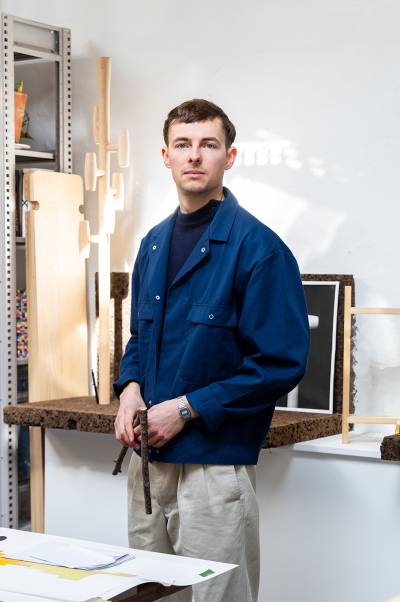
Nicolas Verschaeve
Born in 1995. Lives and works between Brussels and the Northern Vosges.
Through his work as a designer of objects and spaces, Nicolas Verschaeve (BE-LUX) helps to reveal the interplay of forces involved in the emergence of forms and uses. He thus seeks to make visible the imprint of the processes at work in the construction of our physical world. He engages with what extends beyond objects and what precedes them—namely, a set of geographical, historical, social, economic, and political parameters.
His reflections contribute to the fields of design, scenography, curation, and education. He collaborates with cultural institutions such as the International Center for Glass Art in Meisenthal, the CNAP, the Ateliers Médicis, and the Hermès Corporate Foundation, as well as with regional organizations including the Northern Vosges Natural Park. His work is disseminated in project regions through exhibitions and distribution channels, is represented by the A1043 gallery, held in the CNAP collection, and has been presented at the Vitra Design Museum, BOZAR in Brussels, the Ateliers des Arques, the Saint-Étienne Biennale, and the Salone del Mobile in Milan.
In parallel, since 2023 he has been responsible for the educational coordination of the Design des Mondes Forestiers program, led by the EnsAD in Paris and based in the Pays de Bitche region of Moselle.
Nicolas Verschaeve Studio
Team : Théodore Diviné
Scenography for the exhibition Danses interdites
The scenographic proposal for Danses Interdites is set within the Médiathèque José Cabanis, a space dedicated to gathering and sharing cultures from diverse backgrounds. The building is also just a short walk from Matabiau Station, where the unique paths that weave the city’s fabric and fuel its energy intersect, converge, and disperse. A direct metaphor for the way the exhibition’s fabrics—with their variegated colors and patterns—intertwine and knot together, evoking the individual body and shared space, conveying the impressions of movement unique to dance, and posing questions about what is hidden or revealed, about what is glimpsed.
It is also through the Gare district that the city opens onto its wider territory, where goods and riches of various kinds arrive from the valleys of the Tarn and the Hautes-Pyrénées, the plains of Aveyron, or the riverbanks of the Garonne. Across this broader territory of Occitanie, the textile industry persists through a few manufacturers and businesses that resist the standardization of material goods. It is with their collaboration that the scenography takes form, using their scraps and byproducts to reveal the diversity and richness of production methods and ways of bringing material and immaterial culture to life.
Partners:
Eric Carlier, Atelier Passe-trames (Mazamet, Tarn)
Laura Olès, Tissages Moutet (Orthez, Pyrénées-Atlantiques)
Alix De Grandmaison, Tissages d’Autan (Saint-Affrique-les-Montagnes, Tarn)
Julie Jacquenet, Jacquenet-Malin (Touillin, Côte d’Or)
The group exhibition Danses interdites can be viewed at several locations: José Cabanis Media Library, Garage Bonnefoy, Bonnefoy Cultural Center, Les Herbes Folles, and the IPN Artists’ Studio.
À retrouver
-
Danses interdites
exposition
Médiathèque José Cabanis
29 May to 28 June
-
Danses interdites
exposition
Garage Bonnefoy / PPA
29 May to 28 June
-
Danses interdites
exposition
Centre Culturel Bonnefoy & Jardin Michelet
29 May to 20 September
-
Danses interdites
exposition
Les Herbes Folles
29 May to 28 June
-
Danses interdites
exposition
Atelier d’artistes IPN
29 May to 28 June