

Dalila Dalléas Bouzar
Exhibition
Inspired by the history of Spanish exiles, Dalila Dalléas Bouzar has created a series of works for Le Nouveau Printemps : embroideries, paintings, and performances.
When Dalila Dalléas Bouzar visits Les Abattoirs, Musée - FRAC Occitanie Toulouse, or meets with volunteers at the Toulouse Center for Documentation on the Spanish Exile, the work of the great master comes to mind. Guernica, Picasso, 1937. As massacres of populations are taking place in several regions of the world, the memory of the painting comes to the fore. Inspired, the artist travels with Rossy de Palma to the Reina Sofia Museum in Madrid to see the work with her own eyes.
Embroideries
The Massacre of the Innocents, 2026
Dalila Dalléas Bouzar designs an embroidered blanket, which she creates in India with the support of Villa Swagatam and the cooperation of artisans from the Kalhath Institute. She also creates several burnouses (traditional Berber coats) there.
The artist blends references and combines techniques and craftsmanship. She explores them as much as she modernises them. And perhaps, in the face of human catastrophe, Dalila Dalléas Bouzar reminds us of the strength and beauty of the gestures of craftsmanship?
On view at the Bonnefoy Cultural Centre.
L’Arche, 2023 (Velvet, embroidery, beads)
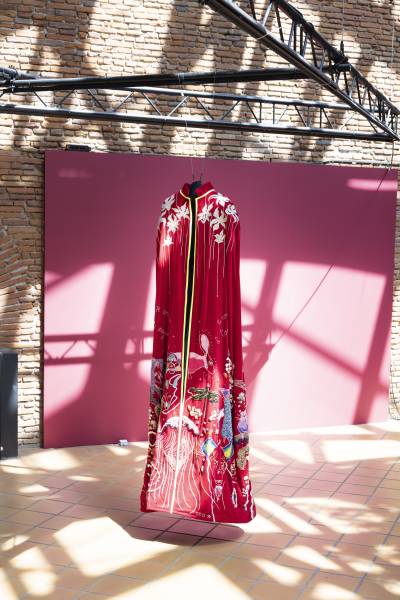
This work is a monumental embroidered burnous, designed and created during Dalila Dalléas Bouzar’s residency in Algeria and following her visit to the Tassili rock art site in the Sahara.
On view at the Bonnefoy Cultural Center.
Burnous (Untitled), 2026 (Wool, embroidery)
Situated at the heart of the exhibition Forbidden Dances, itself at the heart of the Cabanis Media Library, this burnous reminds us of the power of resistance—whether embodied in exile or as a moral quest for shelter, however makeshift, for ideals. As the body’s counterpart, its outer skin, the cloak is a central figure in the artist’s work. It embodies displacement, exile, and nomadism—movements common to all human civilizations—and serves as a symbol of the body’s dignity.
On view at the Cabanis Media Library.
Paintings
The Blood of the Innocents, 2024
On Saturday, March 16, 2024, reenacting a performance by Regina José Galindo to denounce femicides in Guatemala, Dalila Dalléas Bouzar walked through Paris barefoot and covered in blood. The artist walked for an hour and a half, in silence, between Bastille and République, this time “to denounce the massacre of innocents—the tens of thousands of Palestinian women, children, and men murdered by the Israeli army.”
For this painting, the artist drapes the bodies in blankets—the first refuge and sole protection for those who are on the move or displaced. An object of dignity and companionship. Also a recurring motif in the artist’s work, which she continually unfolds.
For Le Nouveau Printemps, the artist has created two series, including a diptych on display at IPN and two small-format works at the Bonnefoy Cultural Center, which, in dialogue with the other works, evoke figures of resistance.
On view at the IPN Studio and the Bonnefoy Cultural Center.
Citizens of the World, 2026, Diptych (paintings, large formats)
These two paintings are inspired by The Citizen (1982–83), a work by Richard Hamilton. Richard Hamilton created three diptychs related to the “troubles” in Northern Ireland. The Citizen depicts a Republican prisoner at Maze Prison wrapped in a blanket. Dalila Dalléas Bouzar discovered this painting very early in her artistic journey; it left such a deep impression on her that it came to haunt her. The artist reflects: “The power of art lies in awakening us to our own ghosts, in setting us on the path to knowledge and liberation.” Dalila Dalléas Bouzar’s diptych offers a new take on this figure of the citizen, “the one we see today on our screens. People on the roads, in the mountains, on boats, together or alone, clinging to life.”
On view at the Atelier IPN.
Performances
Ritual of No Return, 2026
A petite giant wanders through the neighborhood around the train station. Drawing on the tradition of masks and costumes and inspired by the figure of the wanderer, Dalila Dalléas Bouzar, dressed in a burnous, appears at a street corner.
The stroll continues into the former stables of the Bonnefoy Cultural Center: an imaginary house made of red earth evokes the fundamental need for a home. Exile is also the impossibility of returning home.
Elements of the performance are then incorporated into the exhibition on the mezzanine of the Bonnefoy Cultural Center.
RELATED
Dates
-
29 May to 28 June
Atelier d’artistes IPN -
29 May to 28 June
Médiathèque José Cabanis -
29 May to 20 September
Centre Culturel Bonnefoy & Jardin Michelet