

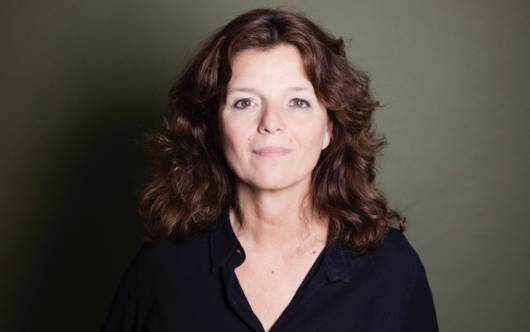
MAYLIS DE KERANGAL, ASSOCIATE ARTIST OF LE NOUVEAU PRINTEMPS 2027
Le Nouveau Printemps and the Centre Pompidou have joined forces to invite Maylis de Kerangal to the 2027 edition on Île du Ramier and along the River Garonne!
Read the press release for the 2027 edition of Le Nouveau Printemps.
Maylis de Kerangal is a writer. She grew up in Le Havre. After studying history, philosophy and ethnology, she worked as an editor of travel guides and then of non-fiction books for young people. She is the author of around fifteen novels and short stories, most of which have been published by Éditions Verticales/Gallimard.
These include Corniche Kennedy (2008), adapted for the cinema in 2018, Naissance d’un pont (2010), a work of fiction set against the backdrop of a major construction project in an imaginary city (winner of the Prix Médicis, the Prix Franz Hessel and the Premio Von Rezzori in 2014), Tangente vers l’Est (Landerneau Prize), and Réparer les vivants (2014), a novel about a heart transplant (winner of twelve literary prizes, including the France-Culture Télérama Students’ Prize and the RTL-Lire Grand Prix, translated into 40 languages, adapted for film and theatre, and winner of the Wellcome Book Prize and the Premio Letterario Merck). That same year, she published À ce stade de la nuit, a nocturne on shipwrecks in the Mediterranean (2014, Éditions Guérin), which was awarded the Premio Boccaccio in 2016. In 2014, she also received the Prix Henri Gal from the Académie Française for her entire body of work. In 2018, Un monde à portée de main was published, a coming-of-age novel about painting that explores the creative process and takes its heroine to the Lascaux IV excavation site.
Her books also take a more documentary approach, as evidenced by Un chemin de table (Seuil, 2016) and Kiruna (La Contre-Allée, 2019). In 2022, she co-wrote a novel with Joy Sorman for Inculte/Dernière marge, Seyvoz, a work of fiction about a village submerged beneath a reservoir.
In 2019-2020, she was an artist-in-residence at the Musée d’Orsay, before being invited to take up the Chair of Literature at Sciences Po in 2020. There, she devised a series of programmes opening up the collections to the perspectives of contemporary authors and thinkers, as well as an exhibition with secondary school pupils on the depiction of reading in paintings. Together with the painter Jean-Philippe Delhomme, she created an exhibition and a book: Légendes des réserves. From 2021, she has been writing a column on the restoration work at the Grand Palais. That same year, she published Chromes in the IMEC’s Diaporama collection, exploring her writing style through some twenty images.
Her work seeks to develop a style centred on attention, driven by an exploration of vocabulary, a focus on detail, and the use of documents and investigative methods. She draws inspiration from the themes of landscape and archaeology, and is interested in the futures of young people, in collectives - trios, gangs, building sites, teams, alliances -, as well as the presence of ghosts and the human voice, as evidenced by the collection of short stories Canoës (2021) and Jour de ressac (2024), a novel whose very essence is that of a city: Le Havre. In 2026, she published La lentille et le roman with Éditions Verdier, a brief literary perspective in the form of poetic art.
“This year’s edition of Nouveau Printemps X Centre Pompidou 2027 will focus on landscapes, the narratives they convey, and the stories they tell. It will be an edition attentive to their vulnerability, their metamorphosis, their collapse or disappearance, the traces of the past they bear, and everything that inhabits or passes through them. What landscapes tell us is the ‘song of the trails’ and
the voices of witnesses; they are also the powerful and intimate bonds that landscapes maintain with memory, dreams, and desire.
To imagine this edition, we needed a landscape in and of itself, and that landscape would be Île du Ramier. An island, then-an island in the middle of a river, which itself lies in the heart of a city. An island that is by turns wild, mysterious, a utopia, a treasure island, and a bird island where the black flycatcher and the kingfisher cross paths. Marked by a long history of industry and sports-including the Poudrière, the hydroelectric plant, and the Nakache swimming pool-and now rewilded or renaturalized, Île du Ramier, once on the city’s outskirts, now opens up a vast space of freedom in the heart of the great Toulouse metropolis. It is the ideal venue for hosting a Biodiversity Forum-a space to be collectively explored in order to reinvent ourselves alongside artists, philosophers, scientists, set designers, filmmakers, writers, poets, performers, and explorers from all walks of life.
I envisaged this edition ‘as a novel’, with the opening weekend dedicated to the Biodiversity Forum and conceived as a prologue to reflect, explore and celebrate our arrival on the island, followed by the four weeks of the festival as four chapters unfolding the island adventure: arriving/mapping, exploring/researching, encountering others/engaging, and settling in.
I am delighted to be this year’s artist-in-residence for this island edition of Nouveau Printemps X Centre Pompidou, and that together we are creating this edition of bridges and walkways, of crossings and mapping, of imagination and creation - an edition dedicated to listening to and observing what the landscapes have to say.” - Maylis de Kerangal.
The entire team at Le Nouveau Printemps would like to extend their warmest thanks to Maylis de Kerangal for her trust and commitment, and to the Centre Pompidou for this new collaboration.
-----
Le Nouveau Printemps by Maylis de Kerangal
Next edition 27 may - 27 june 2027
Île du Ramier / Garonne
Photo Credit : Francesca-Mantovani / Gallimard